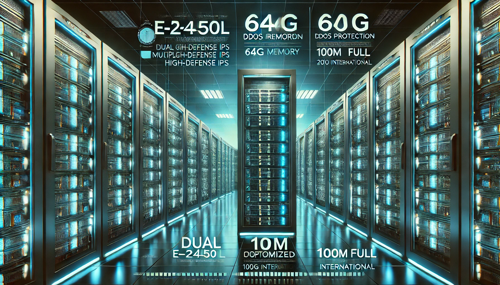
In today's world where internet security is increasingly valued, choosing the right server has become particularly important. High-defense servers in the United States have become the preferred choice for an increasing number of enterprises due to their excellent performance and strong protective capabilities. This article will analyze the five reasons for choosing high-defense servers in the United States and their advantages, helping you better understand their importance.
1. Strong DDoS protection capabilities
One of the most significant advantages of US high-defense servers is their strong DDoS (Distributed Denial of Service) protection capabilities. With the continuous upgrading of network attack methods, the security threats faced by enterprises are becoming increasingly severe. High-defense servers can effectively identify and intercept large-scale DDoS attacks, ensuring that your website and applications remain online at all times. By using advanced traffic cleaning technology, these servers can filter malicious traffic in real-time during an attack, thereby protecting users' legitimate access.
2. High Performance and Stability
U.S. high-defense servers are typically equipped with high-performance hardware, capable of handling a large number of concurrent requests, ensuring that websites remain stable even under high traffic conditions. This high performance is not only reflected in the processing speed but also in the stability of data transmission. By utilizing multiple high-speed network lines, high-defense servers can significantly reduce latency and improve the user experience. Especially for industries with high real-time requirements such as e-commerce and gaming, high-performance servers are crucial.
3. Flexible Resource Allocation
Another major reason to choose US high-defense servers is their flexible resource allocation capabilities. Users can choose appropriate configurations such as CPU, memory, and storage according to their needs to meet different business requirements. This flexibility allows enterprises to expand or reduce resources according to actual conditions during business development, optimizing costs and resource utilization. In addition, many service providers also offer pay-as-you-go models, reducing the operational risks for enterprises.
4. Data Security and Privacy Protection
Data security and privacy protection are important factors that enterprises cannot ignore when selecting servers. U.S. high-defense servers typically follow strict data protection policies and employ multiple encryption technologies to ensure the security of data transmission. Many high-defense servers also provide backup and disaster recovery solutions, ensuring that data can be quickly restored in the event of an accident. These security measures not only protect the enterprise's sensitive information but also enhance customers' trust in the enterprise.
5. 24/7 Technical Support
Choose High-defense server in the United States The final reason is 24/7 professional technical support. No matter whether it's server configuration, troubleshooting, or security issues, a professional technical team can provide assistance promptly. This round-the-clock support not only significantly reduces downtime caused by technical issues but also helps enterprises quickly resume operations when encountering unexpected situations, ensuring business continuity.
Summary and Recommendations
In summary, choosing a high-defense server in the United States offers advantages such as strong DDoS protection capabilities, high performance and stability, flexible resource allocation, data security and privacy protection, as well as 24/7 professional technical support. These factors not only enhance the level of enterprise cybersecurity but also optimize the user experience. For businesses that wish to remain competitive, choosing a high-defense server is a wise decision. When selecting a service provider, it is recommended that enterprises carefully evaluate their technical capabilities and service levels to ensure they choose a high-defense server that best meets their needs.
- Latest articles
- Popular tags
-
How To Set Up Security Protection And Monitoring After Purchasing The American Station Group Server
this article is intended for operations and webmasters who have completed the purchase of servers for the us site cluster. it systematically explains how to set up security protection and monitoring after purchasing the server for the us site cluster, including key measures such as baseline configuration, network protection, log monitoring, alarms and backups. -
-
Understand Why Root Servers Are Mainly Concentrated In The United States
This article discusses why the root server is mainly concentrated in the United States and analyzes many factors such as geography, economy, technology and policy.