Introduction: For enterprises that require a US IP, the choice of cloud server provider directly affects access speed, compliance, and business stability. This article provides a systematic guide for selecting companies and key comparison points from technical and compliance perspectives, helping decision-makers efficiently screen suitable U.S. IP CLOUD server solutions.
Why do businesses need cloud servers with US IPs
?Sources of demand include access to local U.S. services, low-latency access for customers in the Americas, compliance with U.S. data access and authentication, and geo-restricted testing. Once your business objectives are clear, you can focus on key metrics in "A Guide and Comparison of Best Cloud Server Companies Requiring US IP," avoiding blind comparison and feature stacking.
Core considerations when choosing a cloud server
Core considerations include network latency/packet loss, outbound bandwidth and bandwidth limits, IP stability (static or elastic IP), as well as data center location and accessibility. Prioritize quantitative metrics during evaluation, using ping, traceroute, and real traffic tests to observe the performance of reaching target users.
Compliance and legal requirements: Data sovereignty and privacy
Companies should review the legal constraints on data storage and transmission, such as cross-border transfer requirements, privacy regulations, and audit capabilities. When choosing a U.S. IP cloud server, confirm the provider's response process and data access controls for legal requests to avoid subsequent compliance risks.
IP Types and Management Strategies
Understanding the differences between static IP, elastic IP, and shared IP: static and elastic IPs are suitable for external services and filing needs, while shared IPs are suitable for cost-sensitive scenarios. Assess the impact of IP allocation, reverse DNS, IP blacklist handling, and rapid IP switching capabilities on business continuity.
Networking and interconnection: backbone bandwidth, CDN, and peer-to-peer interconnection
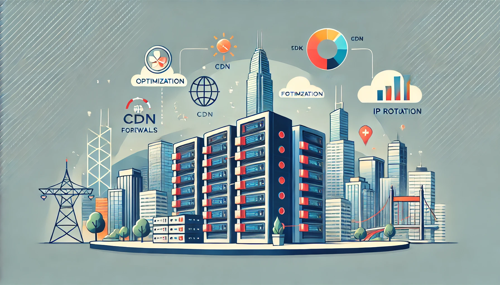
The backbone bandwidth of providers, interconnections with major carriers, and whether they provide global CDN acceleration directly determine the experience for U.S. users. When comparing, focus on the distribution of peering nodes, network access latency, and the stability of transoceanic links.
Security: DDoS protection and perimeter defense
Security capabilities include DDoS mitigation, cloud firewalls, intrusion detection, and log auditing. Enterprises should select the appropriate protection level based on their business exposure surface and confirm cleansing mechanisms and emergency response timeliness during attacks to reduce the risk of service interruptions.
Operations and support: SLA, monitoring, and technical response
High-quality operations and technical support are key dimensions in determining "a guide and comparison for which cloud server requires a US IP." Focus on SLA commitments, 24/7 channel support, fault notifications, proactive monitoring capabilities, and whether custom alarms and interface integration are supported.
Cost transparency and billing model
Costs are not just about unit price; bandwidth fees, traffic billing, IP leasing, and additional security service costs are also accounted for. Prioritize suppliers with transparent billing, flexible scaling on demand, and clear conversion rules to avoid disputes over future billing.
Enterprise selection process and testing recommendations
Suggested process: clarify requirements — develop a scoring sheet — shortlist testing — production trial run. Test items include latency/packet loss, bandwidth peaks, DNS resolution speed, reverse DNS and blacklist checks, and stability assessment under real traffic.
Summary and Suggestions: When answering the question "A guide and comparison for which cloud server requires US IP," you should focus on business objectives and conduct quantitative comparisons across five dimensions: network performance, compliance and security, IP management, operations support, and cost transparency. Conduct thorough trial and stress testing, use a multi-indicator scoring method, and prioritize suppliers who meet business SLAs on key metrics and possess strong compliance and emergency response capabilities.

- Latest articles
- Popular tags
-
Recommendation And Evaluation Of Service Platforms That Support Wechat Payment In The United States
this article recommends and evaluates the us vps service platform that supports wechat pay to help users choose the most suitable service. -

Troubleshooting Collection Helps You Quickly Locate How To Open The Us Cloud Server When You Encounter Problems
this article provides a systematic troubleshooting collection to help you quickly locate how to open the us cloud server when you encounter problems. covers practical troubleshooting steps for network, authentication, system services, log analysis and common scenarios. -

How To Implement The Function Of Overturning The Wall Through Alibaba Cloud US Server
This article introduces how to implement the wall-blocking function through Alibaba Cloud's US server and provides detailed steps and suggestions.